


The Universal Threshold: Exploring the Global History of Jumping the Broom
- aabridal

- Jun 24
- 5 min read
The wedding day is a tapestry of unforgettable moments, but few carry the breathtaking weight of the final leap. When a couple stands before their family, hand in hand, and takes that synchronized step over the broom, the energy in the room shifts. It is a moment of pure, nostalgic triumph. When a couple stands before their family, hand in hand, and takes that synchronized step over the broom, the energy in the room shifts.
As this beautiful wedding broom tradition shows up in more and more ceremonies, a question frequently arises in the digital wedding space:
Can other cultures jump the broom?
To answer this with the reverence it deserves, we must look beyond modern trends and step into the global history of Jumping the Broom. When we look closely, we find a stunning common thread: across centuries and continents, marginalized people have long used the broom as a sovereign covenant, a sacred tool to declare a marriage valid when a hostile state or church refused to recognize their love. We also find cultures that used the broom to celebrate the beautiful, emotional completion of raising a family.
The Global Thread of Sovereign Love
For centuries, when governments refused to recognize love, communities created their own sacred covenant. The tradition became both courthouse and sanctuary.
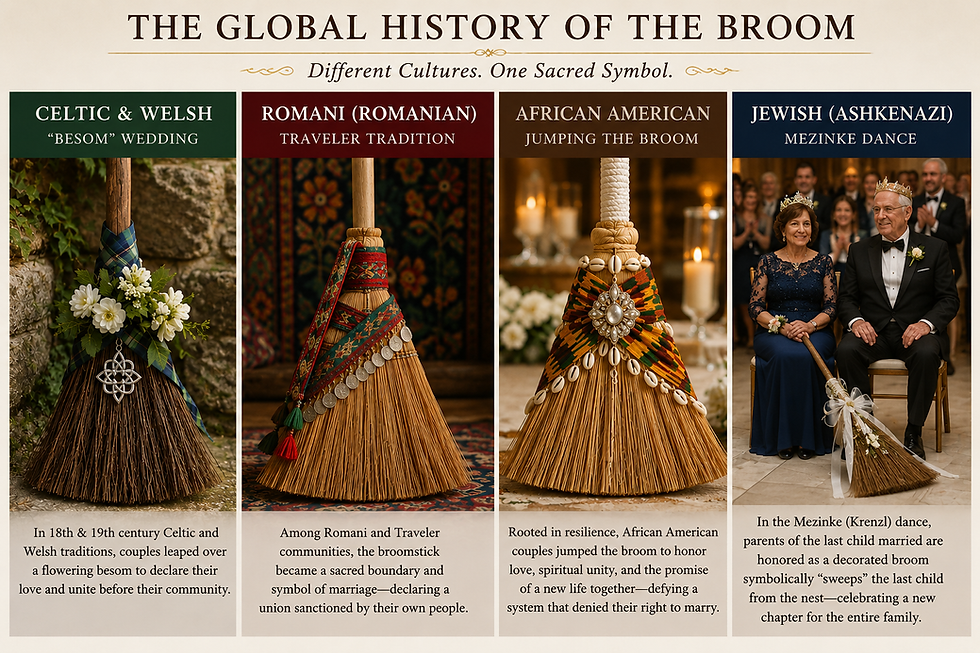
The Celtic & Welsh "Besom" Weddings |Global History of Jumping the Broom
In the 18th and 19th centuries, strict English and Welsh laws made formal church weddings incredibly expensive and legally unavailable to poor, rural, or non-Anglican communities. Refusing to let the state dictate their devotion, couples took marriage into their own hands. Placing a flowering besom, the traditional handmade broom, across the doorway and leaping over it together served as a community-recognized marriage ceremony. It was their way of saying, "The state may not register us, but our community and our ancestors recognize our bond."
Today, many people exploring the origins of Jumping the Broom are surprised to learn about the historical connection to the Celtic broom wedding and the Welsh besom wedding, both of which demonstrate how communities created meaningful marriage traditions outside of formal institutions.
The Romani Traditions |Global History of Jumping the Broom
Similarly, the Romani and Traveler communities of Europe faced intense systemic persecution and exclusion from mainstream civic institutions. Forbidden from using traditional registries, they established their own sacred law. The broomstick became a portable boundary line. By leaping over it into a new camp, the couple declared their marriage sovereign, valid, and fully sanctioned by their own people.
The African-American Legacy: A Holy Defiance | Global History of Jumping the Broom
While European traditions were born out of class barriers and geographic isolation, the African-American experience was a battle against total dehumanization.
Under the brutal system of American chattel slavery, enslaved human beings were legally classified as property. Because property could not legally form contracts, enslaved men and women were forbidden by law from marrying.
But love cannot be enslaved.
Drawing upon African cultural traditions that honored the broom as a symbol of home, cleansing, and family, and adapting those traditions under unimaginable circumstances, enslaved couples chose to leap. In the face of a legal system that tried to strip away their humanity, they looked at each other and said, "We choose to belong to one another anyway."
When an African-American couple jumps the broom today, it is not because they lack a marriage license. It is a triumphant act of remembrance, honoring the resilience of ancestors who loved fiercely against all odds. This enduring custom remains one of the most recognizable African American wedding traditions and continues to shape the modern understanding of the history of Jumping the Broom.
The Jewish Mezinke Dance: Sweeping Out the Last Nestling | Global History of Jumping the Broom
The wedding broom is not always used for jumping. Some cultures use its deep symbolism to honor the parents who built the foundation for the marriage. In Ashkenazi Jewish tradition, a beautiful custom known as the Mezinke Dance, or Krenzl, takes place during the wedding reception.
This dance occurs specifically when a parent has married off their very last child. The parents are seated in the center of the dance floor, often wearing crowns of flowers, while guests dance around them in celebration.
In some families, a decorated broom is used to symbolically sweep the last child from the nest, celebrating the parents' successful completion of raising their family. The Mezinke Dance broom beautifully illustrates how the broom can symbolize transition, gratitude, and the beginning of a new chapter, not only for the newlyweds but for the parents as well.
The Post-Emancipation Shift and the Shadow of Misunderstanding
Following Emancipation, a profound shift occurred. Reclaiming the hard-fought legal right to sign a marriage certificate and marry inside a traditional church was a monumental milestone. In an effort to distance themselves from painful reminders of the plantation era and embrace their new legal status, many newly freed couples put the broom away.
As the decades passed, a new obstacle arose: a deep misunderstanding of ancestral spirituality.
Because traditional African-American culture viewed the broom as a symbol of spiritual cleansing, protection, and new beginnings, outside observers and changing institutions began to misinterpret the tradition. Over time, Western folklore associated the broom with witchcraft. Fearing this stigma, and striving for mainstream religious acceptance, many churches and families gradually moved away from the custom.
The tradition was temporarily silenced, not because it lacked beauty, but because its true meaning had been clouded by fear and misconception.
The Modern Renaissance: Reclaiming the Sacred Tradition
The modern resurgence of the wedding broom tradition did not happen by accident. It happened because history was reclaimed. As families began to study their heritage, they realized this sacred tradition had nothing to do with witchcraft or dark folklore.
Instead, they rediscovered that the broom represented what it always had: a new beginning, a cleansed home, family unity, and a visible connection to those who came before them. They came to understand that the true wedding broom symbolism was rooted in love, remembrance, and legacy, not superstition.
Throughout history, the broom has appeared in different cultures for different reasons, yet a remarkable pattern emerges. Whether marking a marriage that governments refused to recognize, celebrating parents who raised their final child, or honoring the beginning of a new household, the broom consistently represents transition. More than a household tool, it became a visible symbol that one chapter had ended and another had begun.
Throughout history, the broom has appeared in different cultures for different reasons, yet a remarkable pattern emerges. Whether marking a marriage that governments refused to recognize, celebrating parents who raised their final child, or honoring the beginning of a new household, the broom consistently represents transition. More than a household tool, it became a visible symbol that one chapter had ended and another had begun.
The Verdict: Intentionality and Honor (closing)
So, can other cultures use the broom in their weddings?
Yes.
Those who trace their heritage to Celtic, Welsh, Romani, or Jewish roots may discover meaningful historical connections to ancestors who used the broom to affirm their marriages or celebrate important family milestones.
However, the golden rule of this sacred tradition is intention.
The broom is never a prop; it is a testament.
When any couple chooses to incorporate this tradition into their wedding ceremony, it should be done with knowledgeable respect for its history, an appreciation of its cultural significance, and a sincere desire to honor the sacred transition of two families becoming one.


Comments